Technical product guide
EPDM Mass Loaded Sound Barrier
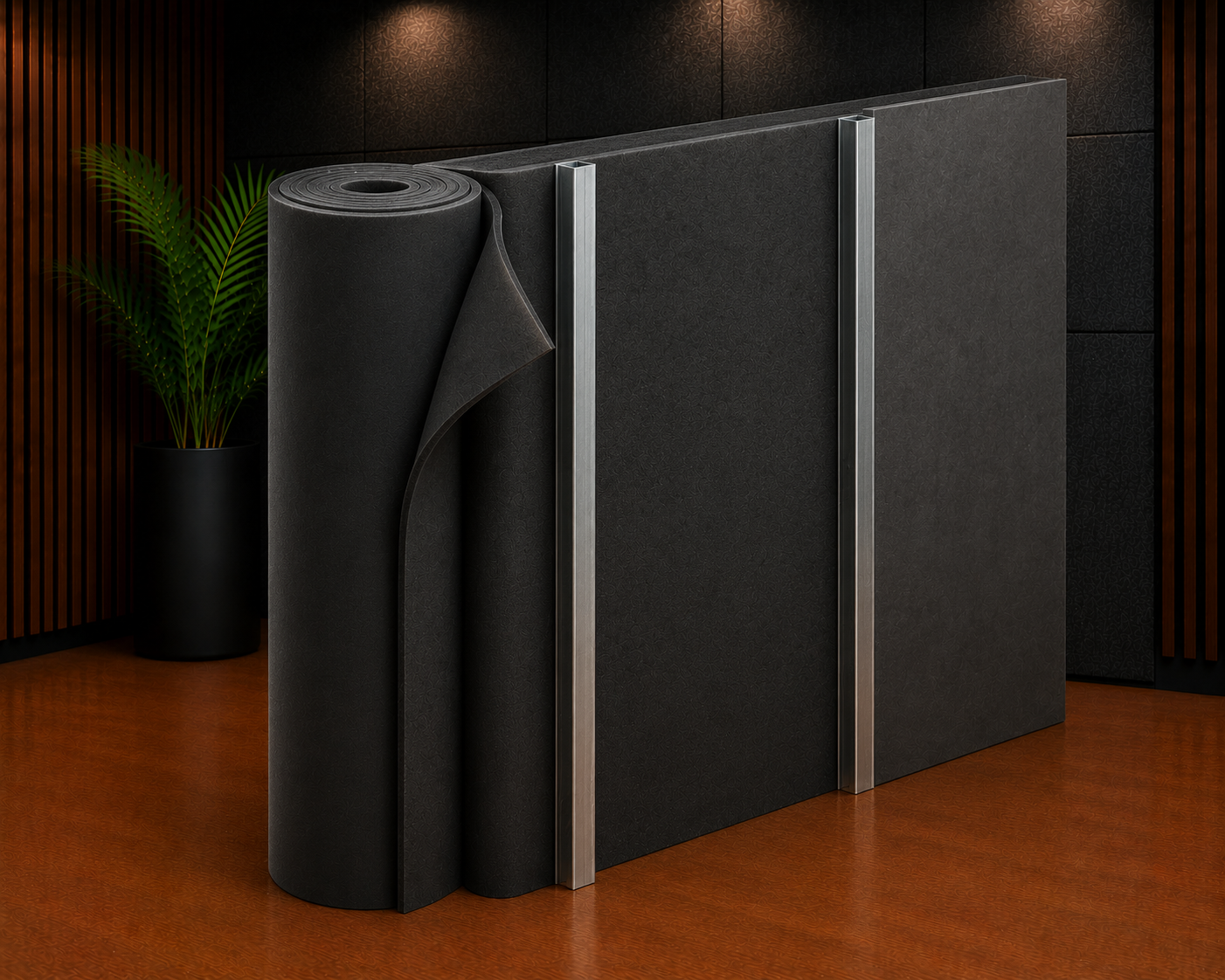
EPDM Mass Loaded Sound Barrier is used in wall, ceiling, floor, service and machinery-enclosure systems and is a flexible high-mass layer that increases surface mass within a slim build-up to help reduce airborne transmission. The result depends not simply on the product name but on room volume, existing surfaces, the sound source, target performance and installation details.
Acoustic treatment and sound insulation are different tasks. Acoustic products manage reflections within a room, while insulation reduces transmission between spaces. Where both aims exist, this product should be treated as one part of a coordinated system.
How does it work?
When sound energy reaches the surface, performance is influenced by material structure, geometry and the layers behind it. Installation without considering strong reflection points, junctions and placement may limit the benefit. Thickness and coverage must reflect the project because low, mid and high frequencies behave differently.
Applications
EPDM Mass Loaded Sound Barrier is considered in wall, ceiling, floor, service and machinery-enclosure systems. Objectives may include speech clarity, reverberation control, recording quality, privacy or limiting equipment noise. The source and receiver positions should be assessed separately in every case.
Product selection
Selection considers dimensions, thickness, density, finish, fire requirements, cleanability, durability and architectural compatibility. A laboratory product rating must not be confused with total on-site system performance. A quotation requires dimensions, photographs, existing construction and a clear description of the problem.
Installation
The substrate must be clean, level and structurally suitable. Adhesive, mechanical fixings, frames, seals or support systems are chosen for the product type. Open joints, sound bridges and uncontrolled cavities must be avoided. Installation is followed by visual checks and an assessment appropriate to the intended use.
Limitations
No single product solves every sound problem. Poor placement, insufficient coverage, weak doors or junctions and structural transmission paths can reduce performance. A precise result should not be promised before the selected variant and complete construction are known.
How is the performance target defined?
A target cannot be defined simply by calling a noise loud or quiet. Frequency content, duration, source-to-receiver distance and room occupancy must be considered together. Manufacturer data for EPDM Mass Loaded Sound Barrier is a useful starting point, but laboratory conditions differ from an actual completed room.
Measurable acoustic-treatment targets include reverberation time and speech intelligibility. Sound-insulation decisions instead depend on the level in the receiving room, the complete building element and flanking paths. Selection therefore begins by establishing whether the objective is room acoustics or transmission control.
Comparison with alternatives
EPDM Mass Loaded Sound Barrier should not be compared with alternatives only by appearance or price. Thickness, density, surface geometry, support system, cleanability and service life matter. A thinner product may preserve space but provide less control at certain frequencies. Decorative compatibility may dominate in public interiors, while impact and maintenance resistance may matter more in technical rooms.
Different products do not perform the same physical task. Absorbers, heavy barriers, resilient layers and diffusers have distinct functions and may be combined. A sound decision compares their role within the complete system rather than treating every acoustic product as interchangeable.
Maintenance and service life
Maintenance depends on the finish. Dust should be removed with controlled vacuuming or the manufacturer's recommended dry method; solvents, excessive water and abrasive chemicals should not be used without approval. Moving products such as doors and booths require periodic checks of seals, hinges, locks and thresholds. Foam and panel surfaces should be protected from impact, heat and persistent moisture.
Service life also depends on storage and installation. Products should be kept dry, protected from deforming loads and retained in suitable packaging until installation. Later alterations to services must not compromise airtightness, fixings or the intended panel layout.
Information required for a quotation
An initial assessment needs room width, length and height; photographs of the proposed surfaces; door, window and service locations; and a description of when and where the problem is experienced. Drawings, sections and specifications help on new projects, while the existing wall, ceiling and floor build-up is valuable for refurbishment.
Colour, texture, quantity, fire requirements, cleaning conditions and the available installation window also affect the scope. Production should not begin before final dimensions are confirmed, and electrical, mechanical or structural obstructions should be identified in advance. This allows both cost and programme to be prepared realistically.
Frequently asked questions
Is EPDM Mass Loaded Sound Barrier sufficient on its own?
Results depend on all surfaces and junctions being assessed together. Other layers may be required.